What the investigation revealed
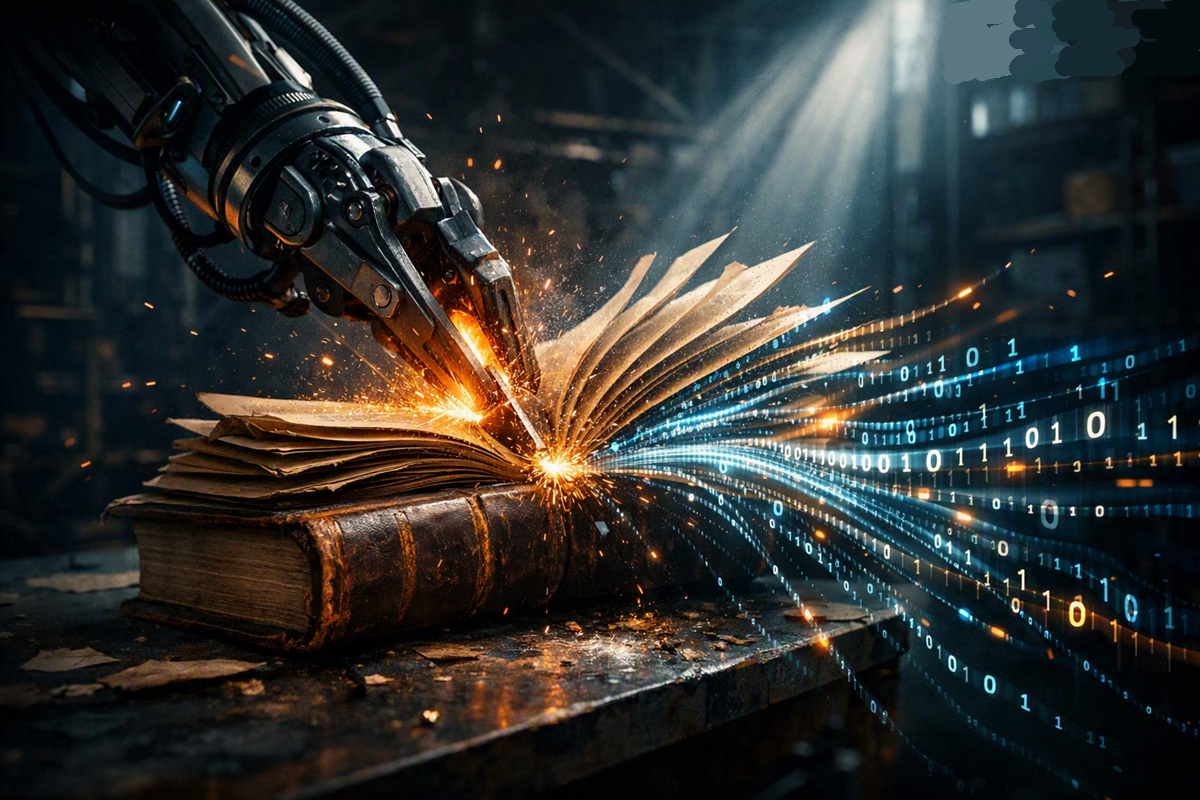
A 404 Media report published on August 17, 2026 hid an AirTag in a 1,000-rare-book order and tracked its journey from California to the LAS8 warehouse in Las Vegas, Nevada. The specific destination: division VGT3, whose entrance displays a logo of a T-Rex clutching a book in its teeth. Employees described the routine as receiving bulk shipments, slicing off spines to separate pages, running volumes through high-speed scanners and discarding the remains. The digitized text feeds Amazon's Nova models.
Why rare books have become gold for AI
The web is saturated with content generated by language models. When LLMs train on this material they produce a phenomenon called model collapse — progressive degradation of output quality as the system ingests its own amplified imperfections. Rare, out-of-print books, especially those published before 2022, offer authentic and irreproducible human text. Amazon confirmed to 404 Media that it "purchases books through commercial channels to improve the products and services customers use" — without mentioning the destruction of the originals.
Legal precedent and global scale
The practice is not exclusive to Amazon. A previous investigation involving Anthropic revealed "Project Panama" — an identical program where books purchased on secondary markets had their spines cut off and were scanned. A court ruled that destroying the physical original after digitizing constitutes "transformative" use and does not violate copyright. The Anthropic settlement with authors was approved in July 2026: 1.5 billion dollars covering approximately 500,000 works, around 3,000 dollars per eligible work. Booksellers report anomalous orders — large volumes, random title selection, all with ISBNs — and suspect that AI companies are systematically working through the global catalog of printed books.